
Part 3 in our series of cable myths focuses on CPR and why, confusing as it might be it’s not going anywhere
“Since Brexit, CPR’s not a requirement in the UK.” Sorry, that’s wrong. Just like many of the rules and regulations that govern our everyday lives here in the UK, not much has really changed since we Brexited and, with respect to CPR that’s a very good thing. The requirement for cables to be CPR tested, classified and certified became mandatory in the UK in July 2017, and that legal requirement remains in place today.
What is CPR?
CPR provides everyone responsible for specifying or selecting a cable for installation the means to compare one against another in respect of its reaction to fire in a way that was almost impossible before its introduction.
Broken down into 7 Euroclass categories, the way a cable will react to fire ranges from “Unknown”(FCA) to “No Reaction”(ACA). Between these 2 extremes are a further 5 categories and 2 testing systems. Products that fall into Euroclass ECA or DCA are tested using System 3, whereas products from CCA through to ACA have to undergo the far more rigorous System 1+.

Choosing your cable
Without going into the nitty gritty of the different testing systems and category requirements (and that’s a lot of nitty gritty to wade through), a simple rule of thumb for anyone selecting cables for installation in public or densely populated buildings (schools, hospitals, offices etc.) would be to head straight for those tested to System 1+ as a starting point. These have gone through stringent testing by an authoritative body such as BASEC and must be retested on a regular basis. System 3 products are tested once with no requirement to be tested again, ever.
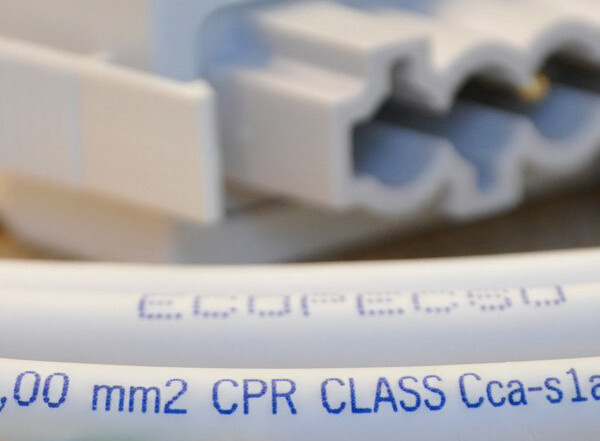
The certification and Declaration of Performance that is issued against a System 1+ product is also far more detailed, and rather than just showing the overarching Euroclassification, for example DCA, goes on to give information relating to smoke propagation, burning droplets of molten material produced and the acidity of any harmful gases emitted–an example would be CCAs1a, d1, a1.
It’s also worth noting that a higher classification can be used where a lower classification is specified, but not the other way round. Remember, CPR is only focused on a cable’s reaction to fire and generally, the higher the Euroclass the more expensive the product. For example, a cable in the ECA class is probably there because it uses PVC compounds which are relatively cheap. At the other end of the spectrum is ACA where we’re looking at something like an MICC cable, and I doubt many of us would expect to buy 100m of Pyro for the same price as 100m of PVC T&E.
The subject of CPR can be daunting, but fundamentally it’s a great tool to have at the disposal of those tasked with cable selection. For that reason alone, we should be glad it wasn’t gleefully lobbed back across the English Channel at the end of January 2020.
So, there we have it. 3 common cable misconceptions that, when taken at face value, seem perfectly reasonable–no doubt the reason they’ve gained traction in the first place. Dig a little deeper though and it becomes obvious why they don’t hold water; BASEC are not the world’s police for cable (and I doubt they want to be); LSF and LSHF cables are produced using completely different compounds; CPR makes cable selection for reasons of safety 100% easier than it used to be.
Related posts

Myth – CPR is no longer important
The requirement for cables to be CPR tested, classified and certified became mandatory in the UK in July 2017, and that legal requirement remains in place today.

Myth – LSF and LSHF Cable are the same thing
The world of cable is, at best, convoluted and, at worst, a massive can of writhing, slippery worms. It’s full of obscure acronyms and complicated standards, so it’s not surprising that, over time, a number of misconceptions have woven their way into the fabric of this vitally important sector of the construction industry. Part 2 in our series of cable myths focuses on LSF and LSHF and if it really matters which you use.
Myth – Cable needs to be BASEC approved
The world of cable is, at best, convoluted and, at worst, a massive can of writhing, slippery worms. It’s full of obscure acronyms and complicated standards, so it’s not surprising that, over time, a number of misconceptions have woven their way into the fabric of this vitally important sector of the construction industry. Probably the one I hear most often is: 'if it's not BASEC approved you can't use it'
It was missed by the government of the time and so when specifying all you can do is ask for a deceleration of performance certificate. If you are in the telecoms or network cabling sphere then things are better as the standards caught up with CPR. Of course I realise that you can pick the cable you want but the example of MICC is slightly misleading as the CPR doesn’t apply to fire survival cables as that is BS8519 ?